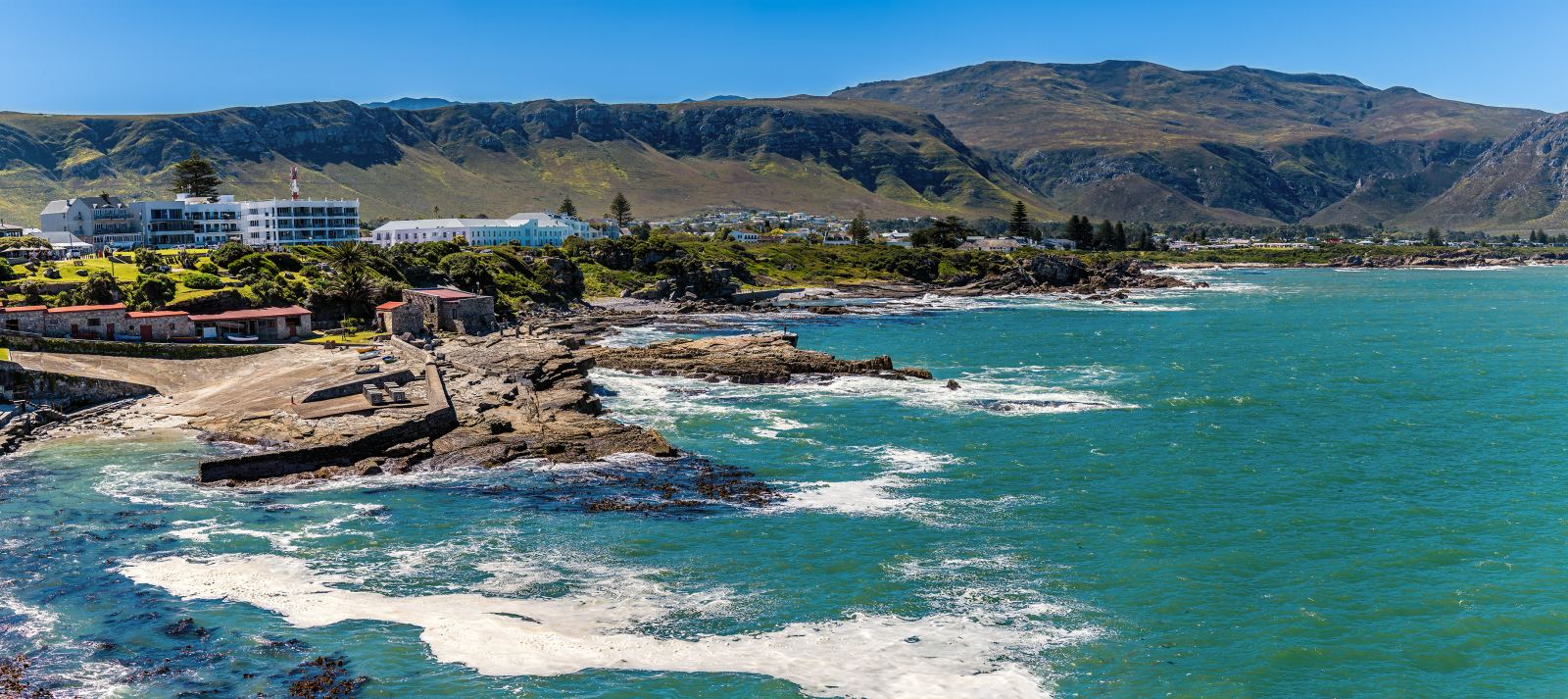
The aircraft touches down a little after nine. Outside it is bright, cool and still, winter at the Cape. By the time you have the hire car it is ten. Then the city is behind you, the N2 runs east past Table Mountain, and from Somerset West the road climbs. Hermanus lies about 120 kilometres from Cape Town airport, a good hour and three quarters of driving. Take the overnight flight and you are standing at Gearing's Point by lunchtime.
The flight
Cape Town takes direct flights from London and from several European hubs, and the flying time is around eleven and a half hours (as of August 2026; winter schedules change every year). Nearly all of them go overnight: away in the evening, down mid-morning. From Australia and the Gulf you connect through Johannesburg or Dubai and arrive later in the day, which is worth knowing when you book the first night.
There is no jet lag to speak of. South Africa sits on UTC plus two and does not change its clocks, so from the UK you are two hours ahead in the British winter and one in the British summer. You land tired, not displaced. A coffee at the airport, and the day is yours.
- Flight from London
- 11.5 hoursnonstop, overnight
- Time difference
- 1 to 2 hoursUTC plus two, clocks never change
- Airport to Hermanus
- 120 kma good 1:45 on the N2 and R43
- Traffic
- drives on the leftautomatic recommended
Two roads out of Cape Town
The quick route is the N2. From the airport you head east, past Somerset West and up over Sir Lowry's Pass. Grabouw sits at the top among apple orchards. Then the Houw Hoek Pass. Just before Botrivier you turn right onto the R43, which carries you through Hawston and Onrus into Hermanus. Without a stop that is about an hour and 45 minutes. Fill up in Botrivier or in Onrus.
The good route is the R44, the Clarence Drive. From Somerset West you keep towards Gordon's Bay, and from there the road clings to the rock face above False Bay for 22 kilometres. Rooi-Els, Pringle Bay, Betty's Bay with the penguins at Stony Point, Kleinmond. The R44 meets the R43 at Botrivier. Around 140 kilometres, two and a half hours once you start stopping for photographs. In whale season you often catch the first blows from this road, long before you reach Hermanus.
How we split it: out on the N2, back on the Clarence Drive. After a night in the air you want to arrive, not photograph. Rested, there is time for the penguins. If Hermanus is your last stop before the flight home, turn it around.
Hiring a car: what to watch
- South Africa drives on the left. Take an automatic and your hands stay where they belong.
- A licence in English with a photograph and signature is accepted as it is. Any other licence needs an International Driving Permit with it, so sort that out before you fly.
- The deposit goes on a credit card. Debit cards are often refused. Check when you book.
- Petrol stations are staffed. Five to ten rand is the usual tip, more if the windscreen gets cleaned.
- There are no tolls on this route. The limit on the N2 is 120, on the R43 mostly 100.
- When the power goes off, every traffic light goes dark with it. Each junction then works on first come, first through.
- Do not drive the N2 between the airport and Somerset West after dark. People and animals cross it, and the lighting gives out in places.
Without a car
It works, with limits. Shuttle operators meet you at the airport and drop you at the door of your guesthouse; they charge per vehicle rather than per person, usually R1,500 to R2,500 each way (as of August 2026, confirm before booking). For four people that beats a hire car over two days. The Baz Bus runs Cape Town to Hermanus for R460 per person (as of August 2026), hostel to hostel, and sells day trips with a boat included.
In Hermanus itself you then need nothing. The centre, the Old Harbour, the Cliff Path and the beaches as far as Voëlklip are all walkable or a short taxi ride. The Hemel-en-Aarde valley and Gansbaai are another matter: without a car, only a booked tour gets you there. So if you are coming carless, stay in the centre rather than in Onrus or Sandbaai.
Which months are worth it
June to August is winter and whale season at once. The first southern rights are in the bay. Prices low, rooms free. July is the wettest month with just under 90 millimetres of rain, days run 15 to 18 degrees and nights around 8. Between the fronts sit clear, windless days. The best of the year for the cliff.
September and October are the peak. The most whales, fynbos in flower up in Fernkloof, and the Whale Festival on the first weekend of October. The price is that houses along the cliff path go months in advance. Want those weeks, book in the northern spring. Through November the whales thin out and the wind picks up; it is the windiest month of the year.
December to March is summer. 25 to 27 degrees, little rain, the sea full of swimmers. South African school holidays from mid-December to mid-January fill the town with families from Cape Town and Johannesburg, and that is when prices peak. Afternoons bring the south-easter, the Cape Doctor, often hard. No whales.
April and May are the quiet months. Warm, little wind, the sea still holding summer's heat, and harvest under way in the Hemel-en-Aarde valley. The visitors have gone, the whales have not arrived. Come now if you want the wine farms and the silence. Wait until June if you want the whales.
Our tipBook the hire car for the day you land, but keep the first drive short. After eleven hours in the air, the N2 is the right road. Not the Clarence Drive. Save that one for the way back, with breakfast at Betty's Bay.
First stop or last?
Either works. As a first stop after landing, Hermanus is a gentle start: short drive, small town, sea outside the window, and the clock more or less right. As a last stop before the flight home it has an advantage most people miss. Flights to Europe leave in the evening. So you get a whole morning on the Cliff Path, set off around midday, and reach the airport with two hours to spare. The car goes back at the terminal, the luggage goes home, and the last thing you saw in South Africa was a whale.
Common questions about getting here
How long does the drive from Cape Town airport to Hermanus take?
A good hour and 45 minutes without a stop, about 120 kilometres on the N2 as far as Botrivier and then the R43 through Hawston and Onrus. Shuttles and the Baz Bus take longer, because they stop on the way.
Can you get to Hermanus without a car?
Yes, with limits. Shuttle operators collect you at the airport and charge per vehicle, usually R1,500 to R2,500 each way (as of August 2026, confirm before booking). The Baz Bus runs hostel to hostel for R460 per person (as of August 2026). In town you walk; for the wine valley and Gansbaai you need a booked tour.
Do you need an international driving permit in South Africa?
If your licence is in English and carries a photograph and your signature, it is accepted as it is. That covers British, Irish, Australian, New Zealand, Canadian and South African licences. Anything else needs an International Driving Permit alongside it. Check the rule for your own licence before you fly, and note that the deposit goes on a credit card, not a debit card.
N2 or Clarence Drive: which route should you take?
The N2 is the quick one, the Clarence Drive (R44) the good one: 22 kilometres cut into the rock above False Bay, with the penguins at Betty's Bay on the way. Our advice: drive out on the N2 after the overnight flight, come back on the Clarence Drive once you have slept.
What is the time difference in Cape Town?
South Africa runs on UTC plus two all year, with no daylight saving. From the UK that is two hours ahead in the British winter and one in the British summer, so there is no jet lag worth the name. Only the overnight flight.
How long is the flight to Cape Town?
Around eleven and a half hours nonstop from London, and much the same from the European hubs that fly the route. Almost every service leaves in the evening and lands the next morning, which puts you in Hermanus by lunchtime on your first day.